

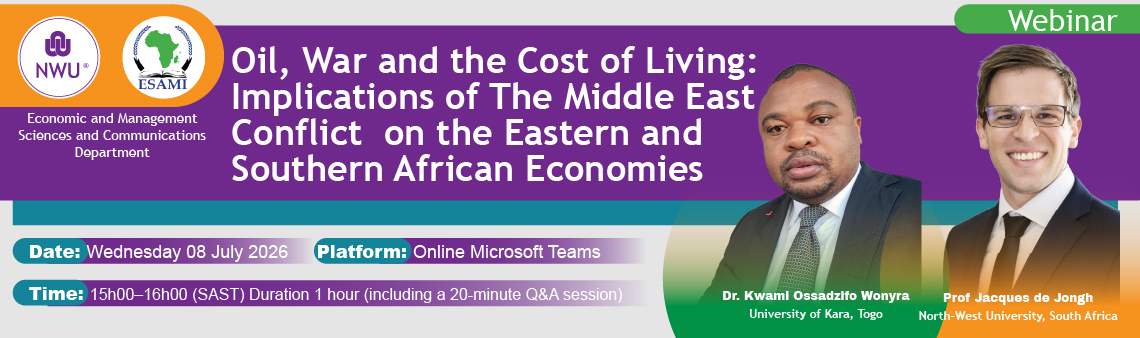
Webinar details
Date: Wednesday, 8 July 2026
Time: 15h00 – 16h00 SAST / 16h00 – 17h00 EAT
Platform: Online (Microsoft Teams)
Duration: 1 hour (20 minutes per expert presentation, followed by a 20-minute Q&A)
Theme: Oil, War, and the Cost of Living: Implications of The Middle East Conflict on the Eastern and Southern African Economies
What the Middle East conflict means for Eastern and Southern African Economies?
The North-West University (NWU), in partnership with the Eastern and Southern African Management Institute (ESAMI), will host a joint webinar examining how the ongoing conflict in the Middle East is reshaping the economic reality at the macro-level across the region.
Titled “Oil, war and the cost of living: What the Middle East conflict means for Eastern and Southern African economies”, the webinar will bring together leading economic voices from NWU and ESAMI to unpack the transmission chain that runs from volatile oil prices and disrupted shipping routes through to the macro-economic pressures shaping the region, including growth outlooks, employment, inflation, and fiscal policy, and how these play out in supermarket shelves, taxi and matatu fares, and household budgets from Cape Town to Nairobi.
Why this conversation matters now
The conflict between Iran and the United States is no longer just a geopolitical headline. As tensions rise, ease, and rise again, the ripple effects are being felt far beyond the Middle East. Volatile oil prices, disrupted shipping through the Strait of Hormuz and the Red Sea, and rattled global markets are feeding directly into the cost of living across Eastern and Southern Africa, moving fuel prices up and down with little warning, inflating food costs, and adding fresh pressure to already stretched regional currencies, including the rand, the Kenyan and Tanzanian shillings, the kwacha, and the pula.
It is not only the direction of these shocks that matters, but their unpredictability. Finance ministries, central banks, and businesses across the region are being forced to plan against a moving target, and that uncertainty itself is now part of the macroeconomic cost of the conflict
For most citizens of the region, the connection between a war thousands of kilometres away and the price of bread, electricity, and transport is invisible. This webinar will make that connection visible, moving from the Strait of Hormuz to the fuel pump, from oil price spikes to supermarket shelves and informal markets, and from port congestion at Mombasa and Durban through to the household budget.
This is not a foreign affairs discussion. It is a kitchen-table conversation about money, cost, and the global forces that African households are paying for whether they chose to or not.
Speakers
Dr. Kwami Ossadzifo Wonyra (ESAMI)
Dr. Kwami Ossadzifo Wonyra is a lecturer and researcher at the University of Kara, Togo, where he teaches International Trade, Trade Policy Practice, Trade Negotiations and Applied Econometrics.
He will set out the regional perspective, examining how volatility in global commodity markets is rippling through economies across Eastern and Southern Africa, with a comparative look at how different economies in the region are absorbing the shock.
Prof Jacques de Jongh (North-West University)
Prof Jacques de Jongh is an Associate Professor in the School of Economic Sciences at the North-West University.
He will open the South African leg of the conversation with a focused analysis of how the global shock travels into the South African economy, through the rand, the basic fuel price, transport, and food inflation, and what households, businesses, and policymakers should realistically expect in the months ahead.
The session will be facilitated by a representative of the NWU CRMS dept.